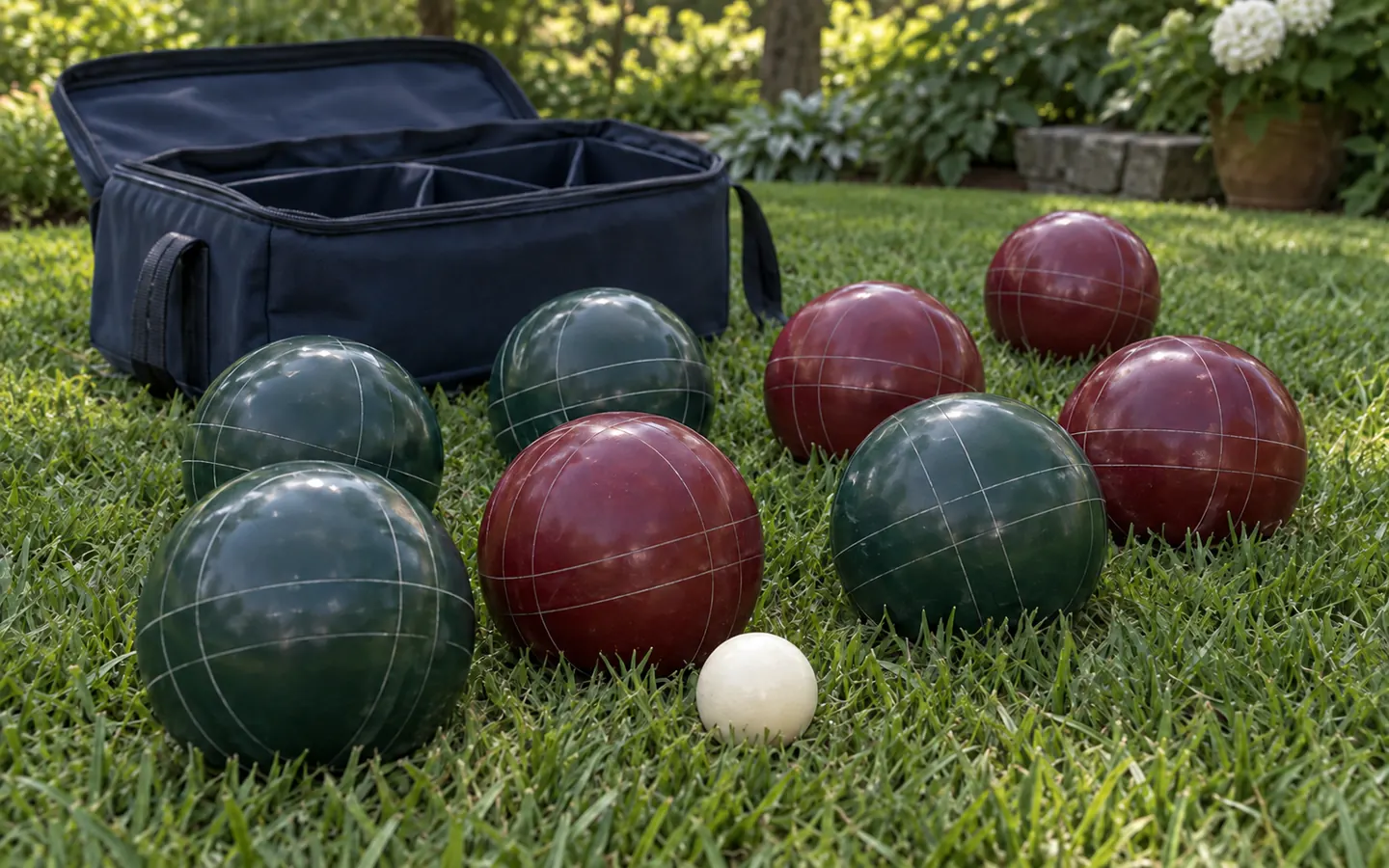
Choose a ball you can handle
Start with ball diameter, weight and the surface you plan to play on. A full-weight resin set suits regular court play; a lighter set is easier to carry to a park. Check the case and pallino as well as the eight playing balls.
| Set or size | Diameter | Weight | Source |
|---|---|---|---|
| USBF tournament standard | 106 to 107 mm | 900 to 920 g (about 2 lb) | USBF open rules |
| EPCO 114 mm | 114 mm (4.5 in) | 1,156 g (2 lb 8 oz) | EPCO product information |
| EPCO 110 mm | 110 mm (4.33 in) | 998 g (2 lb 3.2 oz) | EPCO product information |
| EPCO 107 mm | 107 mm (4.21 in) | 920 g plus or minus 20 g | EPCO; falls inside the USBF range |
| Pallina | 57 mm (2.250 in) | Not published on the EPCO overview | EPCO product information |
| Hollow plastic or water-filled | Varies by brand | Varies by brand, well below the resin figures | Read the individual seller listing |
Resin against hollow plastic and water-filled
Solid resin is the material used for tournament balls. EPCO describes its balls as solid one-piece construction in a thermoset resin composition, which is what allows a consistent 107 mm ball to land at 920 g. Weight is the whole point: a heavy ball holds its line on an imperfect lawn, carries through longer grass, and gives a spock or shot enough mass to move an opponent's ball.
Hollow plastic and water-filled sets weigh less than solid resin, with specifications that vary by brand. Lighter balls are easier to carry and handle for games with younger children, but uneven ground and long grass can interrupt their roll. Read the listed weight before choosing a set.
Diameter, weight and portability
EPCO lists 114 mm balls at 1,156 g, 110 mm at 998 g, and 107 mm at 920 g, with a stated tolerance of ±20 g. The USBF open rules specify 106–107 mm and 900–920 g for tournament balls. A product’s nominal size is not proof every ball meets the event’s requirements; confirm the actual specification and organizer approval.
Eight balls weighing 920 g each total 7.36 kg, or about 16.2 lb, before the case and pallino. Handle a ball if possible before buying: weight, diameter and grip all affect comfort.
A short checklist before buying
Confirm the published diameter and weight rather than the description. Check that the set includes a pallina and that its colour contrasts with both ball colours. Check that each team's four balls include a striped and a plain pair, which is how you tell partners' balls apart in doubles. Confirm the case has a handle or strap that will survive the weight. Finally, check whether replacement single balls are sold, because losing one ball should not retire the set.
Gear to consider
Affiliate disclosure: As an Amazon Associate I earn from qualifying purchases, at no extra cost to you.
 SetsCheck price on Amazon
Franklin Sports Starter Bocce Set
Starter; eight 90 mm balls and 40 mm pallino
A low-cost starter set for family games on grass or sand.
The 90 mm balls are recreational size; this version comes in a carrying box.
 SetsCheck price on Amazon
GoSports 100 mm Resin Bocce Set
Eight resin balls; red/green, 45 mm pallino and case
A full resin set with a divided canvas case for regular backyard play.
Check league specifications before buying: 100 mm is smaller than the 107 mm format used by some competitions.
 SetsCheck price on Amazon
Baden Champions Bocce Set
107 mm; eight polyresin balls, 60 mm pallino, tape and case
Larger 107 mm balls and a measuring tape suit players setting up a dedicated court.
The balls weigh about 2 lb each; check the equipment rules for your own league.
 SetsCheck price on Amazon
GoSports Hardwood Bocce Set
100 mm wooden balls; 12 oz each, pallino and case
Light wooden balls offer an easier-to-carry alternative to a heavy resin set.
This is a recreational wooden set; its weight and roll differ from competition resin balls.
A few common questions
Do I need tournament weight balls for backyard play?
No. Nothing about casual play requires 900 to 920 g balls. The reason to buy near that weight is that heavier balls track more predictably on uneven grass and can actually displace an opponent's ball, which makes the game more interesting once players improve. The reason not to is weight in the hand and in the bag.
Can I use my own balls in a sanctioned game?
The USBF open rules allow players to use their own set of four matching balls if the specifications are approved before the start of the games, and note that tournament directors will usually announce when only house balls may be used. Check with the organiser in advance rather than turning up with a set and hoping.