Setting up the board
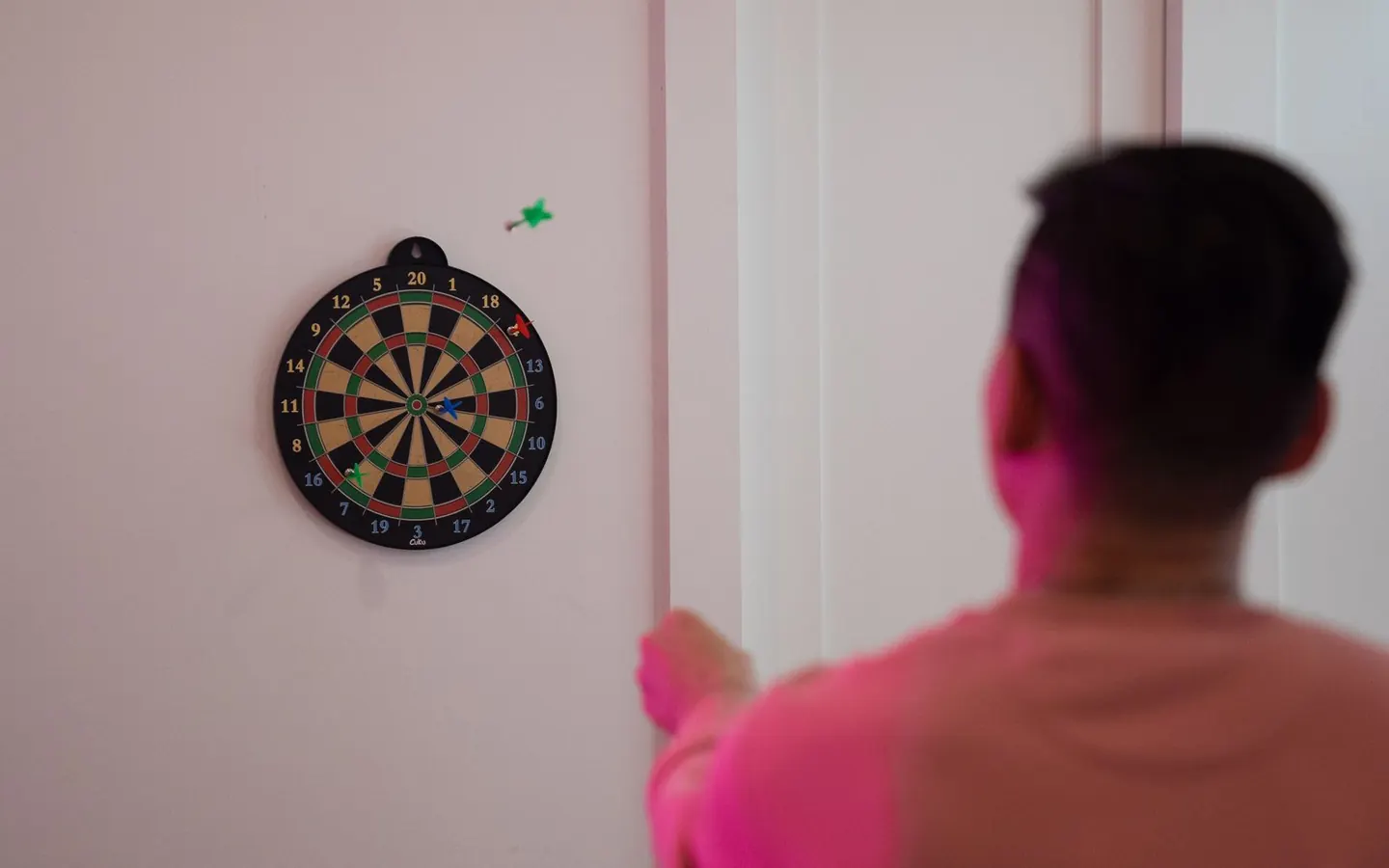
The board is mounted so the center of the bullseye sits 5 feet 8 inches above the floor. The throwing line, called the oche, is 7 feet 9.25 inches from the face of the board measured horizontally.
Because both measurements are fixed, a board mounted too high or a line measured from the wall rather than the board face changes the game noticeably. Measure the horizontal distance from the board face, not from the wall behind it. Leave clear space around the throwing line when other backyard games share the area.
| Element | Value | Notes |
|---|---|---|
| Bullseye height | 5 ft 8 in from the floor | Measured to the center of the bull |
| Throwing distance | 7 ft 9.25 in | Horizontal, from the face of the board |
| Inner bull | 50 | Counts as a double for checkout |
| Outer bull | 25 | Does not count as a double |
| Treble ring | 3x segment value | Treble 20 scores 60 |
| Double ring | 2x segment value | Required to finish a leg |
| Bust | Score reverts | Below zero, exactly one, or zero without a double |
How the segments score
Each numbered segment scores its face value. The narrow outer ring doubles that value and the narrow inner ring triples it, which makes treble 20 the highest single-dart score at 60.
The outer bull scores 25 and the inner bull scores 50. The inner bull counts as a double for finishing purposes, which is why a leg can end on the bullseye.
See the darts scoring and checkout examples for complete visits, doubles and busts.
Playing a leg of 501
Players throw three darts per turn and subtract the total from their score. The leg is won by reducing the score to exactly zero with a dart landing in a double.
Going below zero, reaching one, or hitting zero without a double is a bust, and the score returns to what it was at the start of that turn. That rule is why checkout planning matters, since leaving 1 remaining is an unplayable position.
Legs, sets, and formats
Matches are built from legs, and in some formats legs are grouped into sets. The number required varies by competition and by stage of a tournament.
For casual game nights, first to three legs is a reasonable match length. Adding sets makes matches considerably longer, which is why professional formats specify them explicitly.
Choose your next darts guide
Learn how to play cricket darts for a game built around closing targets. To work on your motion, follow the darts grip, stance and throwing routine.
Gear to consider
Affiliate disclosure: As an Amazon Associate I earn from qualifying purchases, at no extra cost to you.
 BoardsCheck price on Amazon
Winmau Blade 6 Triple Core Dartboard
Blade 6 Triple Core
A bristle dartboard with thin angled wiring and adjustable mounting points.
Confirm Triple Core in the selector; the same page also offers Single Core, Dual Core and Blade X versions.
 DartsCheck price on Amazon
CC-Exquisite Steel-Tip Darts Set
Six 22 g brass darts; spare shafts, flights, tools and case
Two sets of brass darts with spare shafts and flights for trying different setups.
Steel tips are for bristle boards; they are incompatible with soft-tip electronic boards.
A few common questions
Why do you have to finish on a double?
Standard competitive 501 uses double-out: the final dart must be a double. The inner bull qualifies. Other 01 formats can use different finishing rules, so agree on the format before starting.
Is the throwing distance measured from the wall?
Measure from the board face. A cabinet or backboard moves that face forward of the wall, so a line measured from the wall makes the throw shorter than intended.