Set up a cricket scorecard
Write 20, 19, 18, 17, 16, 15 and BULL down the center of a scorecard, with a marks column and a points total for each player. Start with empty columns and zero points. Choose who throws first before the game.
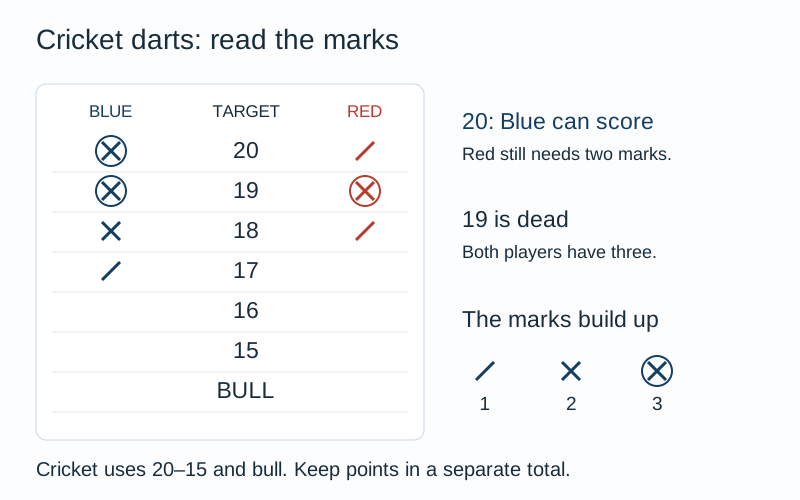
Record one mark with a slash, two with an X, and three with a circle around the X. Our diagram shows a game in progress: the 20 is available for Blue to score on, while the 19 is finished for both players. For the physical setup, use the darts board height and throwing distance.
| Hit | Marks | Points after you close it* |
|---|---|---|
| Single 20 | 1 | 20 |
| Double 20 | 2 | 40 |
| Treble 20 | 3 | 60 |
| Outer bull | 1 | 25 |
| Inner bull | 2 | 50 |
| Any 1–14 | 0 | 0 |
| Target closed by both players | No change | 0 |
Understand marks before adding points
A single counts as one mark, a double as two and a treble as three. The outer bull counts as one mark and the inner bull as two. Numbers below 15 do nothing in standard cricket.
Three marks close a target for you. It becomes dead when both players have three marks, so further hits there add nothing. You can work through targets in any order; the marks stay on your scorecard between turns.
A scoring turn, dart by dart
Suppose you have two marks on 20 and your opponent has one. Your first dart lands in treble 20: one of its three marks closes your 20, and the two extra marks earn 40 points.
Your second dart hits single 20 for another 20 points. A third dart in single 5 changes nothing. That visit adds 60 points, and your opponent’s 20 still has one mark. The darts scoring guide explains how to recognize each ring.
Know when the game is over
Closing all seven targets wins only when your points total also matches or exceeds your opponent’s. If you finish your targets at 120 points while the other player has 140, keep scoring on a target they have not closed.
For example, one extra single 20 takes you to 140. If all your targets are already closed, that tie is enough to win. End the game immediately; you do not need to use your remaining darts.
Choose a target with a purpose
Read both columns before every visit. If your opponent is scoring freely on 20, closing it removes that opportunity. With a points lead, work on unfinished targets; when trailing, identify where you can still score.
Try one complete game after a short darts throwing practice. Agree on the format first: no-score cricket removes points, and cutthroat changes who receives them. Electronic boards and leagues can also impose round limits, so check the selected game rules.
A few common questions
Do all three marks have to come in one turn?
No. Marks accumulate across turns. Three separate singles, a double plus a single, or one treble can close a numbered target.
Can you score on the dart that closes a number?
Yes. Any marks left over after your third mark score if your opponent has not closed that target. Starting with two marks on 20, a treble 20 closes it and earns 40 points.
What does the asterisk in the scoring table mean?
Those point values apply only after you have three marks and while your opponent has fewer than three. Marks used to reach your own first three do not earn points.