Read the dartboard rings
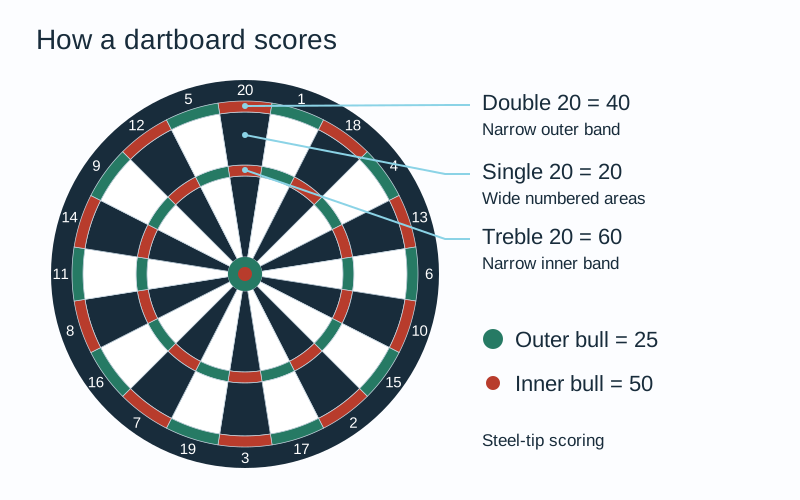
Follow the wedge inward from its printed number. Both wide areas are singles; only the two narrow scoring bands multiply the number. Treble 20 is worth 60, which beats the 50-point inner bull.
The diagram labels the 20 wedge and the two bull areas. S20, D20 and T20 are shorthand for single, double and treble 20. Three T20s make 180, the highest three-dart visit.
| Start | Darts thrown | Result |
|---|---|---|
| 501 | T20, S20, S5 = 85 | 416 left |
| 416 | S19, S19, S7 = 45 | 371 left |
| 60 | S20, D20 = 60 | Leg won |
| 50 | Inner bull = 50 | Leg won |
| 32 | S20, S13 | Bust: back to 32 |
| 32 | S16, S15 | Bust: leaves one; back to 32 |
| 20 | S20 | Bust: zero without a double |
Add a visit, then subtract it
Here is an opening visit in 501: T20 + S20 + S5 = 60 + 20 + 5 = 85. Subtract 85 from 501, leaving 416. Write 85 as the visit score and 416 as the new remainder.
The next visit is S19 + S19 + S7 = 45. Your remaining score becomes 371. Keeping the visit total beside the remainder makes it easier for both players to spot an arithmetic mistake before the next turn.
Finish 501 on a double
A checkout is a visit that finishes the leg. From 40, D20 wins with one dart. From 60, S20 leaves 40 and D20 finishes. You stop throwing as soon as the winning double lands.
An inner bull is also a double: from 50, it can win the leg. Outer bull is 25 and cannot finish standard double-out 501. Check the format before starting; casual straight-out games and electronic-board settings can use different finishing rules.
A bust cancels the whole visit
In double-out play, going below zero, leaving one, or reaching zero with a single or treble is a bust. End the visit and restore the score from its start.
Example: you begin on 32. S20 leaves 12, but your next dart hits S13. The visit is bust and your score returns to 32, not 12. From the same starting 32, S16 followed by S15 leaves one and is also bust. Choosing a clear finishing route before throwing helps you avoid these traps.
Keep the score visible
Call the result while the darts are still in the board, confirm the subtraction, then retrieve them. On a steel-tip board, a bounce-out earns zero and is not thrown again. Electronic machines use their own registration and correction rules.
Cricket uses these same rings to count marks, with points available only on certain targets. Follow the separate cricket darts example for that game. If your arithmetic is improving faster than your accuracy, try the ten-minute throwing routine.
A few common questions
Is bullseye the highest score in darts?
No. Inner bull is 50; treble 20 is 60. Outer bull is 25 on the standard steel-tip scoring system.
What happens if you score too many points?
In 501, the visit ends in a bust and your remainder resets to the score at the start of that visit. You keep the points from earlier valid visits.
Can a treble finish 501?
Not in standard double-out 501. Some other formats allow it, so agree on the finishing rule before the first throw.