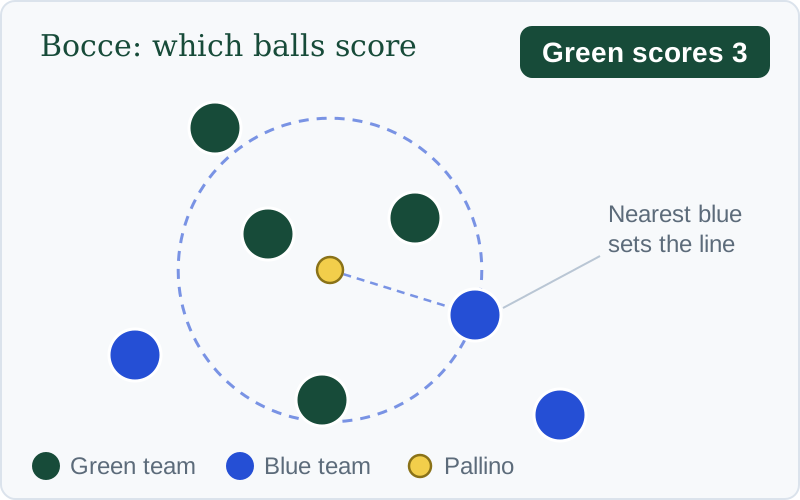
The one rule that produces every score
After all eight balls have been played, find the ball closest to the pallino. That team earns one point for each ball nearer than the opponent’s closest ball, up to four points. The other team scores zero.
Order the eight balls by distance from the pallino and the score reads itself. If the closest ball is green and the second closest is blue, green scores 1. If the first three are green, green scores 3.
| Ball | Team | Distance to pallino | Does it score? |
|---|---|---|---|
| Green 1 | Green | 8 in | Yes, 1 point |
| Green 2 | Green | 11 in | Yes, 1 point |
| Green 3 | Green | 14 in | Yes, 1 point |
| Blue 1 | Blue | 19 in | No, and it stops the count as Blue's closest ball |
| Green 4 | Green | 26 in | No, it is farther out than Blue's closest |
| Blue 2 | Blue | 31 in | No, only one team scores in an end |
| Blue 3 | Blue | 40 in | No |
| Blue 4 | Blue | 55 in | No |
Worked one, two and three point ends
A one point end is the common case. Green sits 8 in from the pallino, blue sits 10 in away, and the remaining six balls are all farther out. Green scores 1, regardless of how many balls each side has left lying around, because blue's 10 in ball caps the count immediately.
A two point end happens when a team gets two balls inside the opponents' best: green at 8 in and 11 in, blue's closest at 19 in, gives green 2. The table above works a three point end all the way through. Green holds 8 in, 11 in and 14 in; blue's nearest is 19 in; green's fourth ball at 26 in is outside that and earns nothing. Green scores 3.
Ties depend on the ruleset you named
Under the USBF open rules a tie is resolved by play, not by splitting points. If a measurement produces a tie, the last team to roll a ball must roll again until the tie is broken. If all balls are gone and the tie stands, no points are awarded at all, and play resumes with the team that last scored throwing the pallino from the opposite end of the court.
Who throws next, and the game total
The team that scored throws the pallino to start the next end. Any team member can roll the first bocce ball. Choosing where to place the pallino changes the distance and angle of the next shots.
The USBF open rules describe 12-point games and recommend 15 points for finals, with tournament directors allowed to set a different target before the event. Announce your target before the first frame.
Gear to consider
Affiliate disclosure: As an Amazon Associate I earn from qualifying purchases, at no extra cost to you.
 SetsCheck price on Amazon
GoSports 100 mm Resin Bocce Set
Eight resin balls; red/green, 45 mm pallino and case
A full resin set with a divided canvas case for regular backyard play.
Check league specifications before buying: 100 mm is smaller than the 107 mm format used by some competitions.
How to Make a Free Tournament Bracket (In Under a Minute)
See how to enter teams, create a single-elimination bracket and share the editable link in Sport Scheduler Pro.
A few common questions
Can both teams score points in the same end?
No. The USBF open rules state that only one team scores in a frame, with a tie as the sole exception, and a tie under those rules produces no points for anyone rather than points for both. If you have ever scored a frame both ways, you were playing a house variation.
What is the maximum score in a single end?
Four points in a standard singles or doubles game, because each team has four balls and all four would need to beat the opponents' closest. It happens rarely and usually means the opposing team never established a point near the pallino. Triples use 12 balls, which changes the ceiling accordingly.
Put your bocce group on the schedule.
Sport Scheduler Pro builds single-elimination tournament brackets and round-robin league schedules. Set your teams and format before the first game.