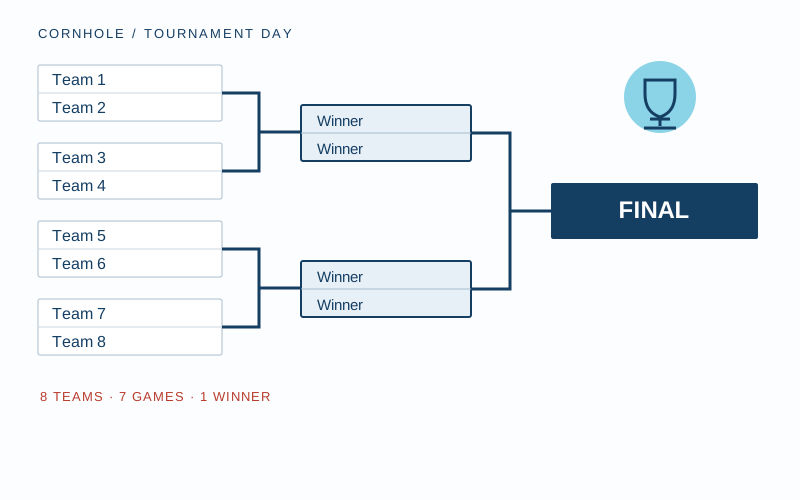
Elimination brackets
Single elimination is the fastest format and the least satisfying for a social event, because half the field is done after one game. It suits large fields with tight time limits or a final stage after pool play.
Double elimination gives every team a second life through a losers bracket. It roughly doubles the number of games compared with single elimination and is the standard choice for a half-day event with 8 to 32 teams. Entries print on a single bracket line, so keep team names short enough to display.
| Format | Games per team | Best field size | Time demand | Notes |
|---|---|---|---|---|
| Single elimination | 1 minimum | Any, especially large | Lowest | Half the field out after one game |
| Double elimination | 2 minimum | 8 to 32 teams | Moderate | Common default for club events |
| Round robin | Number of teams minus 1 | 4 to 8 teams | High | Fairest standings, scales poorly |
| Pool play into bracket | 3 or more | 16 to 64 teams | Moderate to high | Handles staggered arrivals |
| Blind draw doubles | Depends on bracket | Any, social events | Moderate | Balances mixed skill levels |
| Switcholio | Several | 8 to 24 players | High scorekeeping | Tracks individual records |
Round robin and pool play
Round robin has every team play every other team, which produces the fairest standings and the most games per team. It scales badly, so for larger fields split teams into pools of 4 or 5, run round robin inside each pool, and take the top finishers into a bracket.
Pool play also solves the scheduling problem of players arriving at different times, since a pool can start as soon as its own teams are present.
Blind draw and switcholio
Blind draw pairs players randomly into teams, which balances a field with mixed experience and works well for a social or charity event. Players register individually rather than as pairs.
Switcholio rotates partners between rounds so each player accumulates an individual record. It requires more scorekeeping and is best with a system tracking individual results rather than team results.
Planning time and boards
A game to 21 typically takes 15 to 25 minutes depending on skill level. Multiply by the number of games your format produces, divide by the number of boards, and add time for gaps between rounds before committing to a schedule.
Count courts, not individual boards: one cornhole court uses two boards. Sixteen teams in single elimination require 15 matches. With four courts, the first round alone needs two waves; estimate event length from your own observed match duration and include turnover time.
Planning a cornhole league schedule
A round-robin schedule gives a returning group a clear set of opponents. Each team meets every other team once per cycle; an eight-team league has 28 matches in one cycle. Spread those matches across the weeks and courts you have available.
Before week one, publish the scoring rules, how results should be submitted and how tied standings will be resolved. Give teams a way to report an absence before game night, and leave room for make-up matches.
How to Make a Free Tournament Bracket (In Under a Minute)
See how to enter teams, create a single-elimination bracket and share the editable link in Sport Scheduler Pro.
A few common questions
How long does a cornhole tournament take?
Estimate 15 to 25 minutes per game, multiply by the games your format generates, and divide by available boards. A 16-team double elimination bracket on 4 boards commonly runs several hours.
What format is fairest for mixed skill levels?
Pool play into a bracket, or blind draw for a social event. Both give weaker teams multiple games instead of a single knockout.
Put your cornhole group on the schedule.
Sport Scheduler Pro builds single-elimination tournament brackets and round-robin league schedules. Set your teams and format before the first game.