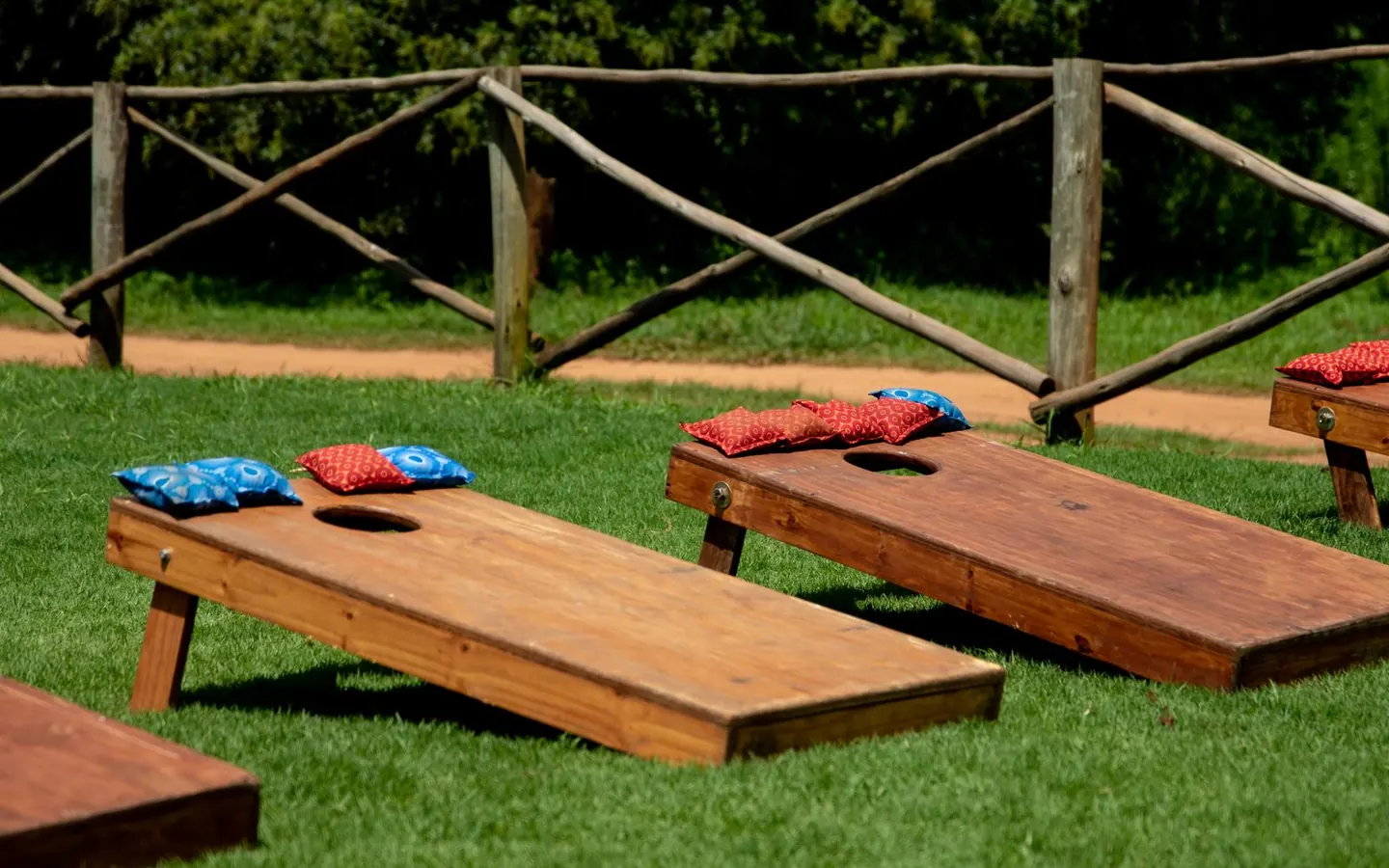
Space you actually need
The playing area is 27 feet between board front edges plus 4 feet of board at each end, giving 35 feet. Add several feet behind each board for players standing and for bags that carry long, and 45 feet of usable length is a comfortable target.
Width is easy to underestimate. Each board needs a pitcher's box 3 feet wide on the side you throw from, and in doubles two players stand at each end. Ten feet of width keeps people out of each other's swing.
| Element | Measurement | Notes |
|---|---|---|
| Board front edge to front edge | 27 ft | Regulation distance |
| Total lane length including boards | 35 ft | Two 4-ft boards plus the 27-ft gap |
| Recommended usable length | About 45 ft | Room to stand behind each board |
| Pitcher's box | 3 ft wide x 4 ft long beside each board | Front edge of the board is the foul line |
| Single lane width | About 10 ft | Both throwing sides plus clearance |
| Spacing between lanes | 10 to 12 ft center to center | Keeps throws from crossing |
Getting the boards level
Set each board so it does not rock and so the surface is level across its width. A side-to-side tilt is worse than a slight difference in slope, because it pushes every bag the same direction and players spend the game unknowingly compensating.
On grass, legs sink into soft ground unevenly. Flat pavers, scrap plywood, or square offcuts under the rear legs spread the load and hold the rear height near 12 inches. On a slope, orient the lane across the slope rather than up and down it, so both boards sit at similar heights.
Multiple lanes
For more than one lane, leave at least 10 to 12 feet between lane center lines so players are not throwing across each other. Align all boards facing the same direction so spectators and traffic move behind the lanes rather than through them.
For events, plan a walking route around the outside of the lanes and keep chairs and coolers off the throwing sides. Most stoppages at casual tournaments come from foot traffic rather than from disputes. How many lanes you need follows from the number of teams and the tournament format you run.
Light, wind, and surface
Evening play needs light on the board surface without shining into the throwers' eyes. Lights placed to the side of each board at low height work better than a single bright source behind a lane.
Wind affects lofted throws more than flat ones, so a lane oriented across a prevailing wind gives more consistent play than one thrown into it. Grass, dirt, and pavement all work as long as the boards sit stable, though bags landing on pavement wear faster.
Gear to consider
Affiliate disclosure: As an Amazon Associate I earn from qualifying purchases, at no extra cost to you.
 BoardsCheck price on Amazon
GoSports Solid Wood Cornhole Set
4 × 2 ft; two boards, eight bags and case
Full-size wood boards for a permanent backyard setup, with a plain surface you can personalize.
Decals and custom artwork are not included.
 AccessoriesCheck price on Amazon
Tailgating Pros Board Carrying Case
Heavy-duty 1680D case for 4 × 2 ft boards
A padded shoulder strap and one cover make a pair of boards easier to move.
Check the listed 123 × 62 × 22 cm dimensions against your boards and folded legs.
A few common questions
Can I set up cornhole on a slope?
Yes, if you orient the lane across the slope rather than up and down it and shim the legs so each board sits level across its width. A lane running downhill makes one direction play noticeably differently from the other.
How much room do I need behind the boards?
A few feet at minimum for players to stand, and more if bags regularly carry past the board. Around 45 feet of total length covers a comfortable single lane.
Put your cornhole group on the schedule.
Sport Scheduler Pro builds single-elimination tournament brackets and round-robin league schedules. Set your teams and format before the first game.