Measure before you buy
For cornhole, measure 27 feet between board fronts plus the two 4-foot boards: 35 feet overall. Add clear access beside and beyond the equipment. For each other game, use its rules or manufacturer setup instructions rather than a single space allowance for all sports.
Measure the longest clear run in your yard, then subtract for trees, slopes, and anything breakable in the flight path. A game that technically fits but requires throwing toward a window will not get played.
| Game | Space to plan | Equipment / surface |
|---|---|---|
| Cornhole | 35 ft end to end, plus clear access | Two boards; firm, level footing |
| Bocce | Ruleset-dependent court or agreed lawn area | Eight balls and pallino; inspect slopes |
| Ladder toss | 15 ft toss line in Ladder Golf rules; allow clearance | Stable ladders and compatible bolas |
| Croquet | Marked course with room to swing | Mallets, balls, wickets and mown grass |
| Badminton | 13.4 m court length, plus runoff | Net, rackets, shuttle; low wind |
| Darts | 2.37 m from board face for steel-tip, plus safe surroundings | Secure board and backstop |
| Horseshoes | Dedicated pitching area; check the chosen rules | Stakes, shoes and protected landing pits |
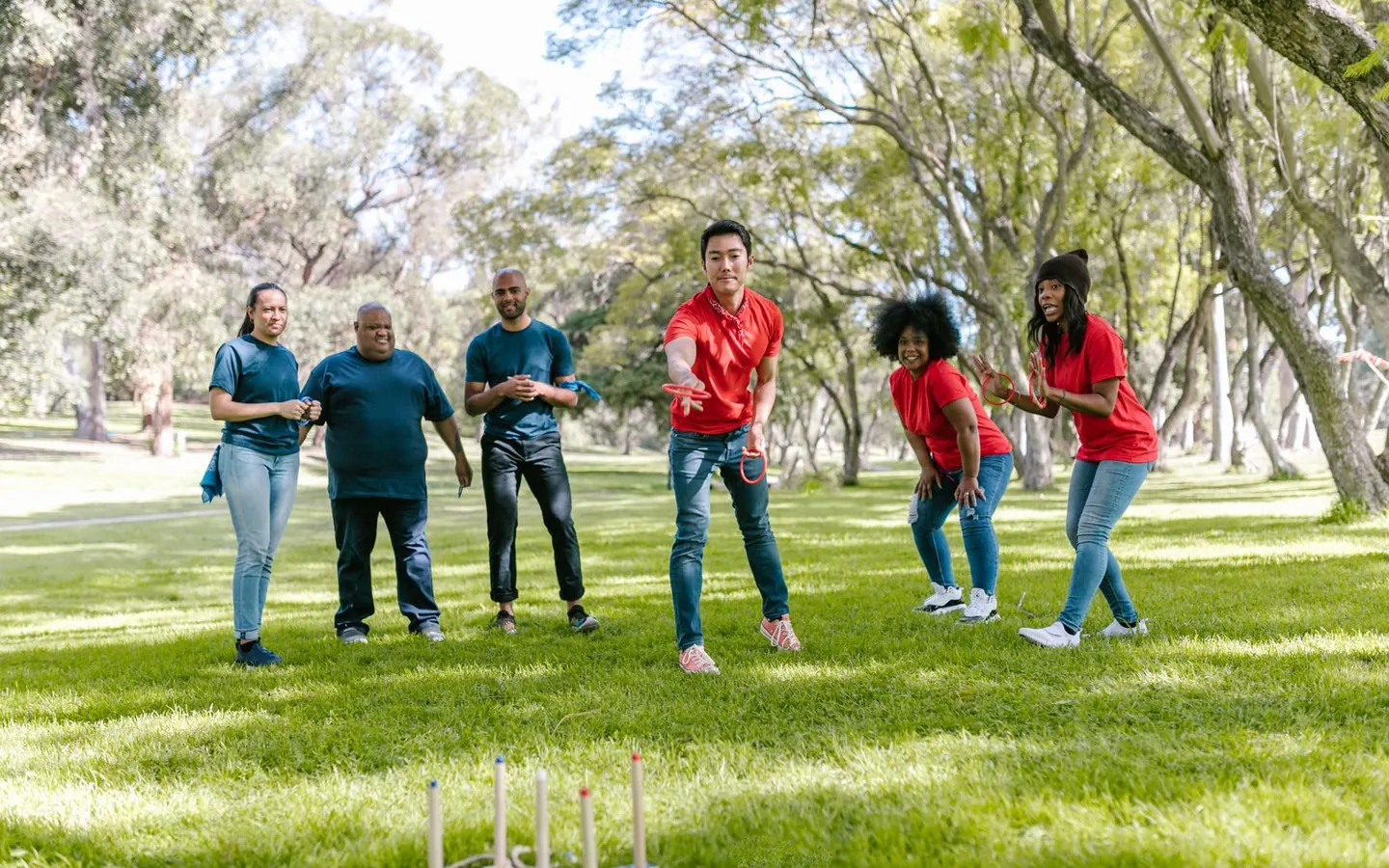
| Ring toss | Manufacturer’s toss line and clear landing area | Target pegs and matching rings |
| Disc golf putting | Short target area with clear space beyond | Basket and appropriate discs |
| Kubb | Marked rectangle sized to the chosen rules | Wooden targets and throwing batons |
| Flying-disc target game | Manufacturer’s spacing plus retrieval space | Two targets and disc |
| Washer toss | Agreed distance for the particular set | Target boxes and washers |
Match the game to the group
Games where players take turns at a target, including cornhole, bocce, and ladder toss, work well for mixed groups because people can drift in and out without stopping play. Games with continuous rallies, such as badminton or spikeball, need everyone present and moving for the whole game.
For a group with a wide age range, turn-based target games let a child and an adult play the same round without a handicap system. Adjusting throwing distance for younger players keeps one game rather than splitting the group.
Ground surface and weather
Flat ground matters for anything involving rolling or standing equipment. Bocce and croquet are affected by every slope and divot, and cornhole boards need to sit stable and level across their width. Toss games with a soft target are the most tolerant of uneven ground.
Storage and weather resistance shape what survives a season. Wooden equipment left outside deteriorates; resin and composite equipment tolerates it better. Anything with fabric, including cornhole bags, needs to come indoors and dry out.
Setup time is a real cost
Check the assembly steps before buying. Folding boards, a net with tensioning poles and a course of wickets create different setup tasks; choose one someone in your group can manage.
For frequent casual play, favor low setup. For a planned event, longer setup is worth it because the effort is spread across many hours of play.
Gear to consider
Affiliate disclosure: As an Amazon Associate I earn from qualifying purchases, at no extra cost to you.
 BoardsCheck price on Amazon
Himal Outdoors Foldable Cornhole Set
3 × 2 ft fabric boards; eight bags and case
Lightweight fabric targets that fold flat for camping and trips to the park.
The flexible surface and smaller boards play differently from regulation wood boards.
A few common questions
What backyard game works in the smallest space?
Stacking games and short toss games such as ladder toss need the least room. Bocce adapts to whatever length is available because the court size is not fixed for casual play.
Which games work for a group with both kids and adults?
Turn-based target games. Cornhole, bocce, and ladder toss all let players of different sizes compete in the same round, particularly if younger players throw from a shorter distance.