What the open rules actually cover
The United States Bocce Federation publishes a short document called the Open Rules, last updated 3/23/23, and describes itself as the only internationally sanctioned governing body for bocce in the United States and a member of the Federation International de Boules and the Confederazione Boccistica Internazionale. It is worth reading in full because it is only a few pages, and because it is explicit that it is a guideline intended to make play consistent rather than a single fixed code.
The equipment list is short. You need a set of 8 balls, four matching balls for each team in different colors, and a target ball. The rules also recommend a measuring device, and list tape measures, antennae, expanding pens, string devices and laser measuring tools as options that are commonly used.
| Stage | What the open rules say | What to agree on in a casual game |
|---|---|---|
| 1. Coin flip | Winner picks the end and controls the pallino; loser picks ball color | Agree a starting side any way you like; the flip is a tournament convention |
| 2. Pallino toss | Valid between the center line and the far foul line, touching neither | On open lawn there is no center line, so agree a minimum toss distance |
| 3. First ball | Any member of the team that threw the pallino rolls first | Works unchanged on a lawn |
| 4. Establishing the point | That team rolls again until a valid point is established | Works unchanged on a lawn |
| 5. Handover | Opponents must point or shoot until they make a new closer point | Casual groups often just alternate throws instead |
| 6. End of frame | All eight balls played, closest team scores, that team throws the pallino next | Agree the winning score before you start |
Starting a frame and whose turn it is
A game begins with a coin flip between the team captains. The winner decides which end play starts from and takes control of the pallino; the losing team picks its ball color when house balls are used. The pallino toss is valid when the ball comes to rest between the center line and the far foul line without touching either line. If the thrower fails, the opposing team puts the pallino in play, and if both fail the attempt alternates back until the pallino is in a valid position.
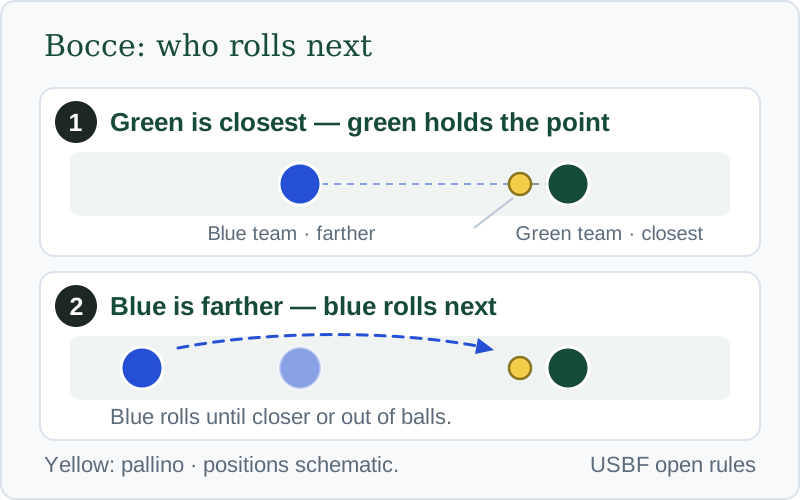
The team that originally threw the pallino plays the first ball, and any member of that team may roll it. That team keeps rolling until it establishes a valid point. Once the point is established, the opposing team must point or shoot until it makes a new closer point, at which stage the obligation switches back. Within a team, consecutive or alternating throws by teammates are at the option of the players.
Measuring and ties
Balls can be measured at any time, and in case of doubt the rules direct players to call a referee or tournament official. If a measurement produces a tie, the last team to roll a ball must roll again until the tie is broken. If all balls have been played and the tie still stands, no points are awarded, and play resumes with the team that last scored tossing the pallino from the opposite end of the court.
Only one team member may cross the center line to measure; everyone else stays at their own end. If balls are moved by an official during a measurement they are returned to approximate positions and the official still makes the call, but if a member of the team currently playing measures and moves a ball, the point is awarded to the opposing team.
Dead balls and the back wall
The USBF term for the strict version is Back Wall Dead: a thrown ball that touches the back wall before touching any other ball or the pallino is void and is removed from the court, and any balls it struck afterwards go back to their previous positions. Back Wall Live is described in the same document as a more lenient house rule under which every thrown ball that hits the back wall is valid and stays where it lands.
The pallino is always a valid target and stays in play even if it hits the back wall after being struck by a valid ball. If the pallino is knocked out of the court, or bounces back in front of the center line, the frame is void and the team that started the frame begins again at the same end.
Casual open bocce compared with court play
Most backyard bocce has no side boards and no back wall, so the dead ball rules above simply do not apply, and there is no center line to make the pallino toss valid or invalid. Settle four things before the first throw: the winning score, whether the back wall is live if you have boards, where the foul line sits, and how you will handle a tie for closest ball. The USBF recommendation on court is a single line for both pointing and shooting, 13 ft from the back wall.
A few common questions
Is there a universal winning score in bocce?
No. The USBF open rules say games are usually played to 12 points and that finals are usually played to 15, which is a USBF recommendation rather than a fixed number, and they explicitly allow tournament directors to set any variation as long as it is announced before the event. Any other total you see quoted is a house or league choice.
Can two players on the same team throw one after the other?
Yes under the USBF open rules, which state that consecutive or alternating throws by teammates are at the option of the players. The obligation to keep throwing belongs to the team that does not hold the point, not to a specific player, so a team can send its strongest shooter twice in a row.
Put your bocce group on the schedule.
Sport Scheduler Pro builds single-elimination tournament brackets and round-robin league schedules. Set your teams and format before the first game.