The figure that is actually sourced
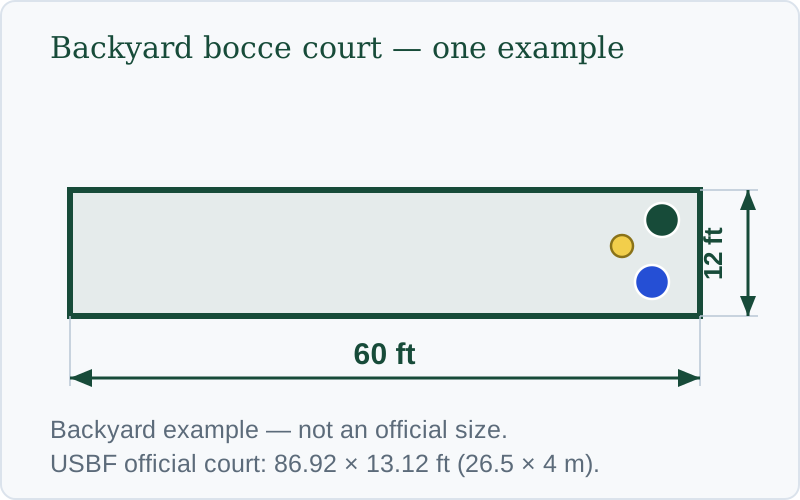
Under the USBF open rules, official courts are 86.92 ft in length and 13.12 ft in width. Those numbers are conversions of 26.5 m by 4 m, the dimensions commonly used for dedicated international courts. The same rules recommend one foul line for both pointing and shooting at 13 ft from the back wall, and require foul lines to be clearly marked on both the court surface and the side boards.
The USBF also notes that court surface has the greatest variation found in the USA, listing carpet, crushed stone, dirt, oyster shells, clay, and more recently synthetic carpets and poured liquid surfaces that play smooth and extremely fast. Surface changes how a court plays far more than a few feet of length does.
| Design | Length | Width | Status |
|---|---|---|---|
| USBF official court | 86.92 ft (26.5 m) | 13.12 ft (4 m) | Official figure, USBF open rules |
| Three-quarter length | about 65 ft | 13.12 ft | Unofficial design choice; keeps official width |
| Half length | about 43.5 ft | 13.12 ft | Unofficial; half the official length, arithmetic only |
| Narrow backyard strip | 40 ft | 8 ft | Unofficial; below official width, so bank play dominates |
| Marked lawn, no boards | Whatever the lawn allows | Whatever the lawn allows | Unofficial; USBF notes unofficial courts can be smaller |
Why there is no universal number
Different bodies and different national traditions publish different court sizes, and recreational courts in the United States vary widely because most were built to fit an existing space rather than to a specification. The USBF open rules acknowledge this directly by allowing unofficial courts to be smaller. Club courts, park courts and restaurant courts frequently sit well under the official length.
The practical consequence is that a quoted dimension only means something with a ruleset attached to it. If you are building for sanctioned play, work from the governing body running the event and confirm the figure with them before pouring anything.
Planning a smaller court
The official court has an aspect ratio of roughly 6.6 to 1, so shortening a court while keeping full width leaves you with a proportionally wider playing surface and a shorter roll. That is a reasonable trade for a backyard, because shorter courts favour precise pointing over long approach rolls and are far more forgiving of a surface that is not perfectly true.
The designs in the table below are planning options, not standards. No governing body specifies them. Before committing to any of them, check the run of the ground, allow walking room at both ends and along at least one side, and confirm that the space still works once boards and any surrounding path are added.
What to check before you measure the yard
Measure the usable flat area and assess its slope before selecting a court size. Decide if side boards and a surrounding path are part of the design; both affect the space and construction work required.
Gear to consider
Affiliate disclosure: As an Amazon Associate I earn from qualifying purchases, at no extra cost to you.
 SetsCheck price on Amazon
Baden Champions Bocce Set
107 mm; eight polyresin balls, 60 mm pallino, tape and case
Larger 107 mm balls and a measuring tape suit players setting up a dedicated court.
The balls weigh about 2 lb each; check the equipment rules for your own league.
A few common questions
Is 26.5 m by 4 m the official bocce court size?
It is the dimension the USBF open rules give for official courts, expressed there as 86.92 ft by 13.12 ft. It is widely used for dedicated international courts, but bocce is governed by several bodies with their own documents, so treat it as the USBF figure rather than as a single global standard and confirm with whoever is sanctioning your event.
How short can a backyard bocce court be?
There is no published minimum. The USBF simply states that unofficial courts can be smaller. Length is limited in practice by how far you want the pallino to travel and by how much flat, well-drained ground you have, so measure the usable level area first and design the court to fit it.