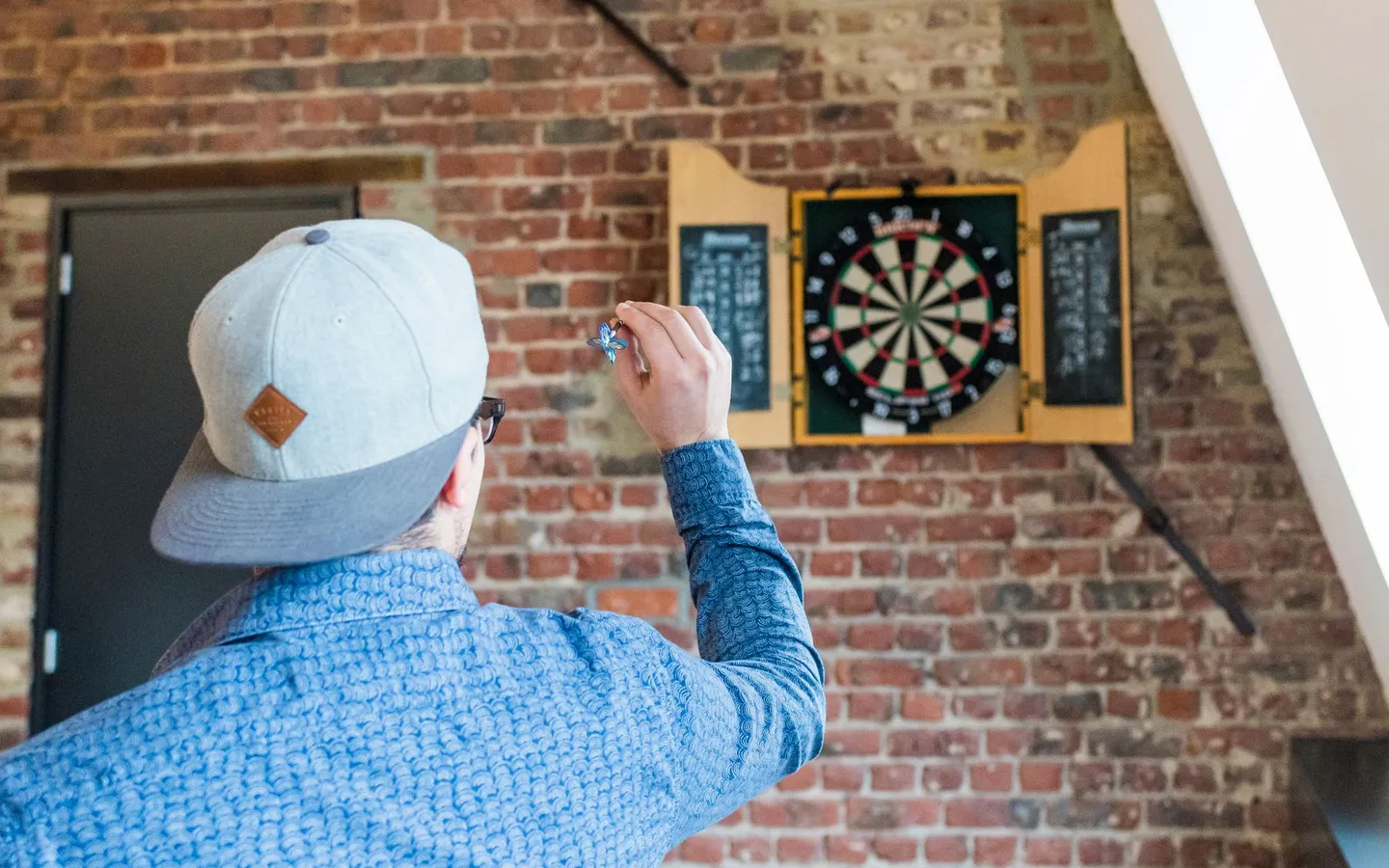
Set your feet before raising the dart
For a right-handed throw, start with your right foot forward; reverse that for your left hand. Keep both feet behind the throwing line and choose a sideways or angled stance that lets you stay balanced throughout the motion.
Use the same foot position for each visit. Avoid leaning so far forward that you need to step or lift yourself to finish the throw. Check your board height and throwing distance before using scores to judge progress.
| What you notice | A check to try | How to compare |
|---|---|---|
| Your body moves forward | Finish with feet planted and head steady | Watch a side-view recording |
| Your grip changes each dart | Choose one reference point on the barrel | Compare three visits without changing it |
| Hits scatter vertically | Keep the draw-back and release rhythm consistent | Record several visits at one target |
| You chase every missed dart | Aim at the same spot for the whole visit | Compare groups rather than single throws |
| Practice has no clear result | Count hits in one chosen wedge | Log the count before switching targets |
Find a grip you can repeat
A useful starting grip is thumb and index finger around the barrel, with the middle finger supporting it. Pick up the dart at the same place each time and hold it securely without squeezing hard.
Two-, three- and four-finger grips all have users. Adjust for comfort and a clean release instead of forcing your hand into another player’s position. Keep one setup for a practice session so you can tell what a change actually does.
Aim, draw back and follow through
Choose a small visible spot inside your target segment. Raise the dart into your aiming position, then bring your forearm back in a controlled motion. Send it forward with enough force to reach the board and allow your fingers to release together.
Let your hand continue toward the target after the dart leaves. Keep your head and torso steady rather than lunging. Treat these steps as a starting motion; your comfortable elbow angle and release height will depend on your stance and grip.
Spend ten minutes on one useful drill
Try this routine: use the first two minutes to warm up with relaxed throws at a large single area. Spend the next four minutes throwing at single 20, counting how many of each three darts land anywhere in its wedge.
For three minutes, alternate visits at single 19 and single 18. Use the final minute to record your hit counts and one observation, such as a grip that felt easy to repeat. This is a suggested practice routine; the counts give you a personal baseline, not a universal rating.
Change one thing, then compare
A scattered group does not identify its own cause. Use the checks below to choose one adjustment and compare several visits before changing anything else. A quick side-view recording can help you see movement you did not notice while throwing.
Once you can repeat the motion, practice the targets used in cricket darts or the doubles in our darts scoring examples. Keep steel-tip darts for bristle boards and use the specified soft tips on electronic boards.
Gear to consider
Affiliate disclosure: As an Amazon Associate I earn from qualifying purchases, at no extra cost to you.
 BoardsCheck price on Amazon
Winmau Blade 6 Triple Core Dartboard
Blade 6 Triple Core
A bristle dartboard with thin angled wiring and adjustable mounting points.
Confirm Triple Core in the selector; the same page also offers Single Core, Dual Core and Blade X versions.
 DartsCheck price on Amazon
CC-Exquisite Steel-Tip Darts Set
Six 22 g brass darts; spare shafts, flights, tools and case
Two sets of brass darts with spare shafts and flights for trying different setups.
Steel tips are for bristle boards; they are incompatible with soft-tip electronic boards.
A few common questions
How many fingers should hold a dart?
Start with three if you are unsure: thumb, index finger and a supporting middle finger. Other grips can work. Comfort and a repeatable release are more useful than a fixed finger count.
Should beginners aim at treble 20?
Begin with a larger single area if treble 20 gives you no useful feedback. Count hits in the intended wedge, then narrow the target as your grouping improves.
Will heavier darts fix my throw?
A different weight changes the feel, but a purchase does not establish a repeatable motion. Practice with one matched set before comparing equipment.