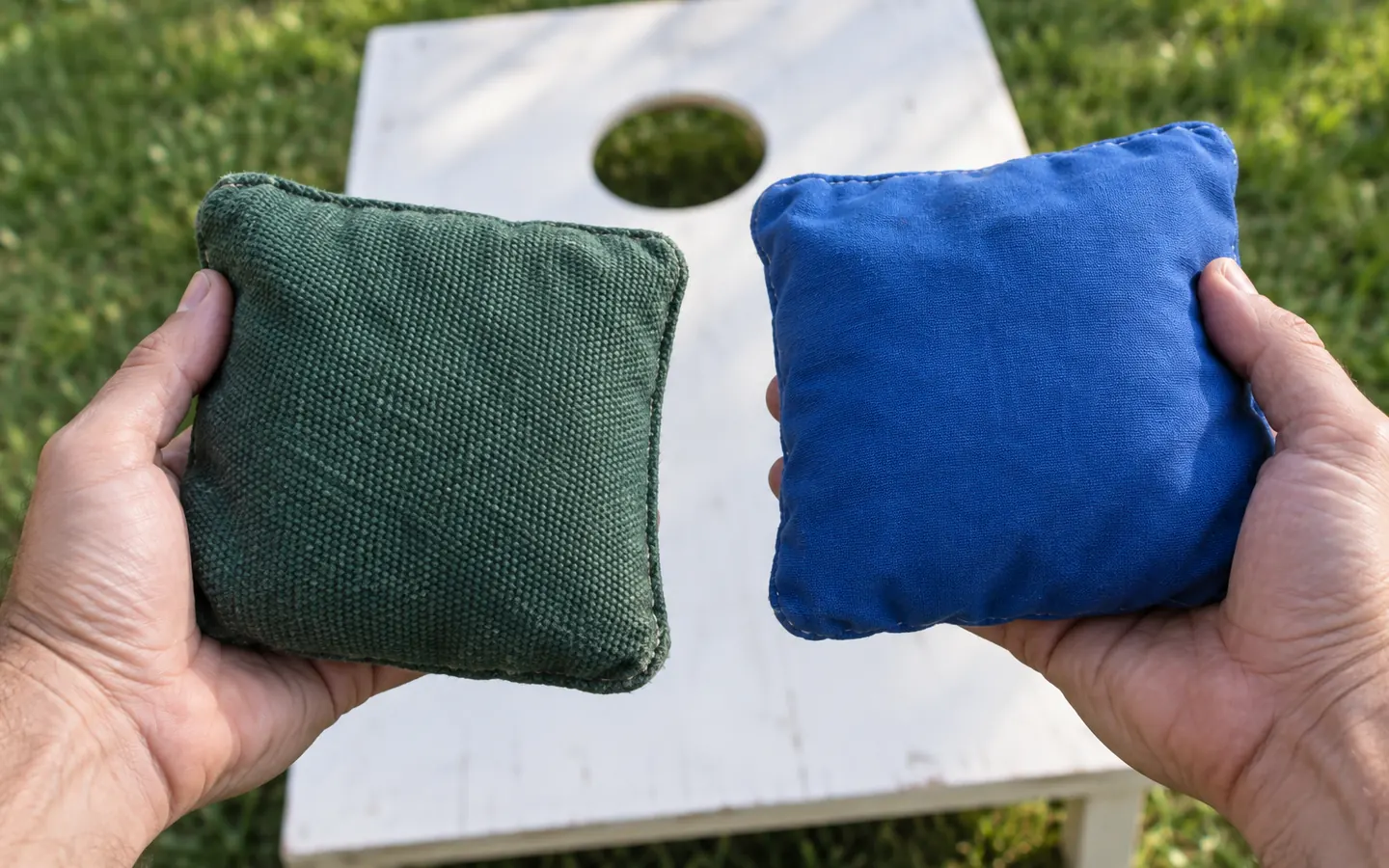
What the two sides do
The slow side is the higher-friction face. Landing on it, a bag decelerates quickly and tends to stay where it lands, which is what you want for a blocker sitting in front of the hole or a bag placed on a specific spot.
The fast side is smoother and carries momentum. It is used for pushing a blocker through the hole, sliding a bag up the board from a shorter landing, and for slide shots that need to travel after touching down.
| Face | Behavior on landing | Typical shot | Risk |
|---|---|---|---|
| Slow side | Grips and stops near the landing point | Blocker in front of the hole | Bag stalls short of the hole |
| Fast side | Carries and slides after landing | Push shot, slide into the hole | Slides through the back of the board |
| Balanced bag | Similar both sides | Simple, consistent backyard play | Less control in tight board states |
| Worn slow side | Slides when you expect a stop | None, replace the set | Unreliable feedback while practicing |
| Wet fabric | Unpredictable, usually faster | None, dry the bags | Changes mid-game as bags dry |
How ratings are published
Bag manufacturers publish speed ratings on different scales. Read the legend to identify which number belongs to each face. A 4/8 label is useful only with that maker’s scale and conditions; it cannot establish how another brand will play.
There is no governing standard behind those numbers. Each manufacturer sets its own scale, so a 5 from one brand may feel like a 7 from another, and the numbers are best read as an ordering within a single brand's lineup.
Matching speed to your throw and your boards
A player who throws with a flat trajectory and lands bags on the back of the board generally wants more separation between the two faces, since the fast side does the work of getting the bag down the slope. A player who lofts bags and lands them softly near the hole gets more use out of a grippier slow side.
Board surface interacts with all of this. A slick board makes every bag effectively faster, and a rougher board narrows the practical difference between the two sides. That is why the same bags feel different at a different venue.
Speed changes as bags wear
Fabric polishes with use. The slow side loses grip first, which compresses the gap between the two faces and gradually removes the choice the bag was designed to give you.
If a set has started sliding when you expect it to stop, that is wear rather than technique. Replacing all 8 bags together keeps the feedback consistent while you recalibrate.
Gear to consider
Affiliate disclosure: As an Amazon Associate I earn from qualifying purchases, at no extra cost to you.
 BagsCheck price on Amazon
GoSports Slide & Stop Cornhole Bags
Eight bags; Stars and Stripes; 6 × 6 inches, 16 oz
A canvas sliding face and suede-like stopping face let you practice choosing a bag side.
No current ACL approval was verified for this listing.
A few common questions
Which side should I throw with?
Present the slow side when you need the bag to stop where it lands, and the fast side when you need it to travel after touching down. Most players default to one side and switch for specific shots.
Is a higher speed number better?
No. The numbers describe friction, not quality, and the right combination depends on your trajectory and the boards you play on.