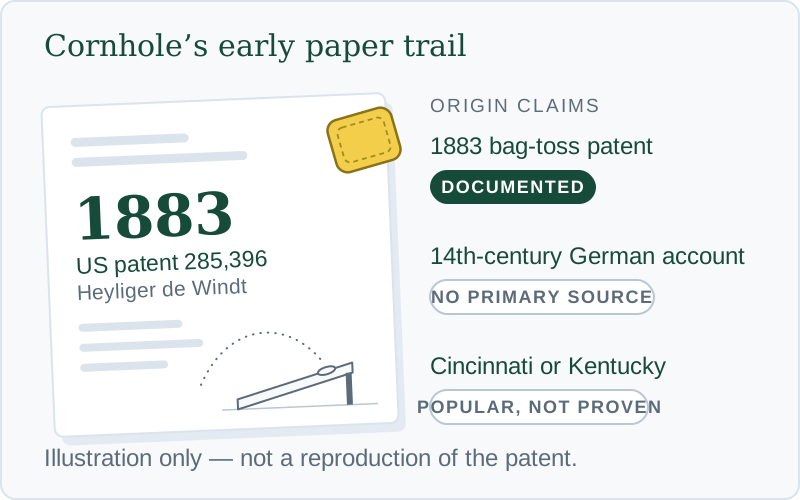
The 1883 patent
United States patent 285,396, granted to Heyliger de Windt in 1883, covers a bag-tossing game played at an inclined board with an opening. It is the earliest widely cited document describing equipment that resembles what is used today, and the full text is available through public patent archives.
A patent shows that someone described and claimed a design at a point in time. It does not show that the design was manufactured at scale, that people played it widely, or that it connects by any traceable line to the game played now.
| Claim | What is cited | Evidence status |
|---|---|---|
| 1883 bag-toss patent | US patent 285,396, Heyliger de Windt | Documented patent, no proven line to today's game |
| 14th-century German cabinet maker | Repeated on hobby sites | No primary source produced |
| Cincinnati origin | Local tradition and regional popularity | Popularity documented, invention not |
| Kentucky origin | Regional tradition | No primary source produced |
| Modern standardization | Published league rules and dimensions | Documented and current |
Why the origin story stays unsettled
Several origin accounts circulate: a Cincinnati origin, a Kentucky origin, and a medieval German account attributed to a fourteenth-century cabinet maker. None of these is supported by primary documentation that has been produced publicly, and the German account in particular is repeated across websites without a source.
Bag-toss games in general are old and appear in many places, which makes single-origin claims hard to support. The reasonable position is that the modern standardized game emerged through informal regional play rather than from a documented invention event.
How the modern game got standardized
What is well documented is the recent part. Organized bodies published dimensions and rules, which is why a board is now 48 by 24 inches with a 6-inch hole centered 9 inches from the back edge, and why the pitching distance is 27 feet.
The American Cornhole League and the American Cornhole Organization are two of the bodies publishing rules today, and they are separate organizations. Standardization of equipment and scoring is what allowed league play, brackets, and televised events to exist at all.
Naming
The game goes by several regional names, including bags and baggo, and the name cornhole is tied to the traditional corn fill in the bags. The early regional use of these names remains uncertain.
Corn fill itself has largely been replaced by resin in competitive play, so the name now describes a material most tournament bags no longer contain.
A few common questions
Who invented cornhole?
No inventor has been established by evidence. An 1883 patent by Heyliger de Windt is the oldest commonly cited document for a similar game, and it does not demonstrate a direct line to the modern sport.
Did cornhole start in Cincinnati?
Cincinnati and the surrounding region are strongly associated with the game's popularity, but that association does not amount to documented evidence of invention there.